Independent. No commercial relationship with UnGovr
— no funding, no agreement, no conversation of any kind — checked 9 September 2026.
Disclosures · how every claim here is evidenced
Notes. This is the entire pitch in three sentences. If you say nothing else, say this. The gap is not in their data and not in the standards — it is between them, and it is one edge.
What we plan to build · slide 2 of 10
The number that carries the argument
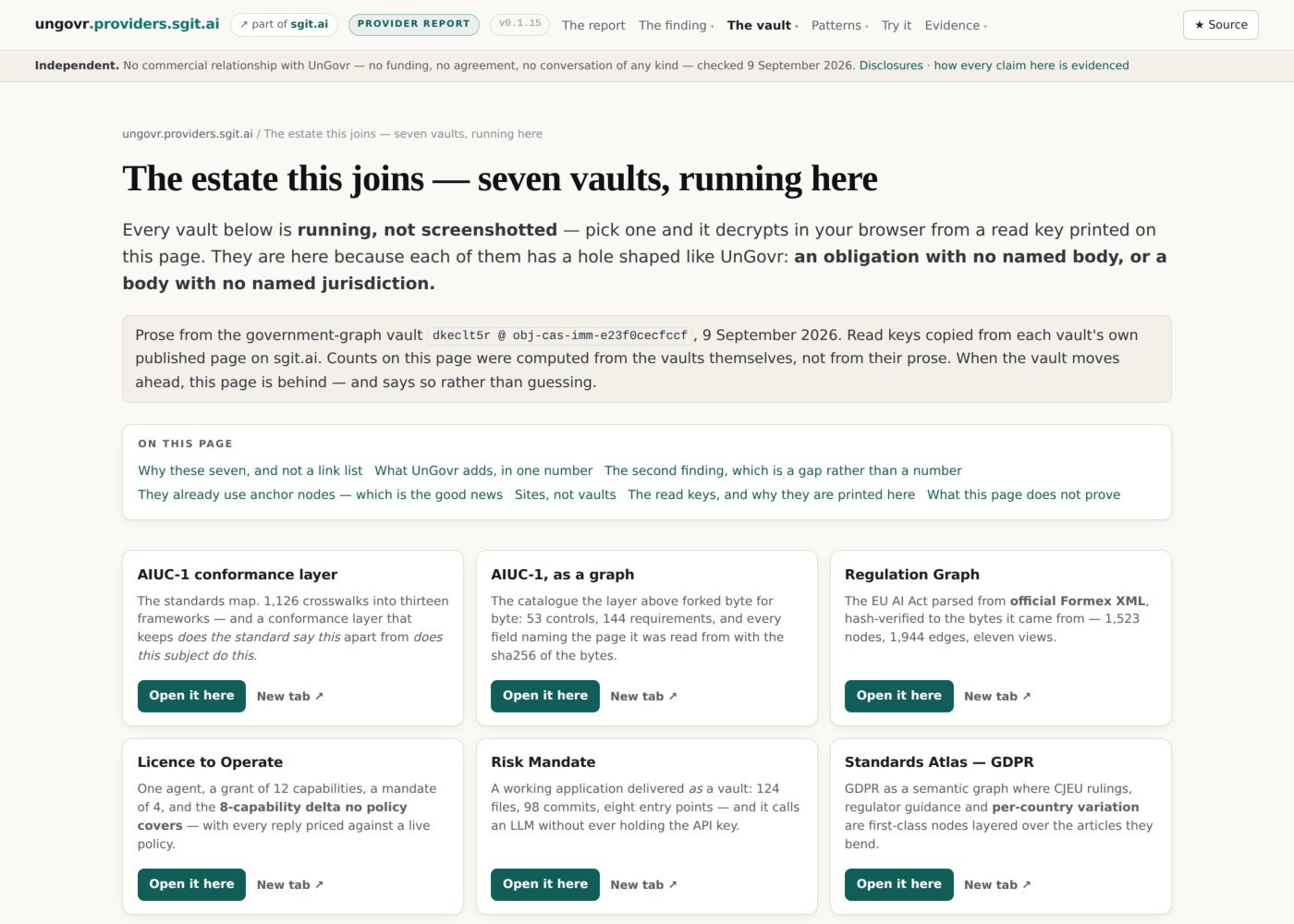
AIUC-1's conformance vault holds 1,126 crosswalks from its controls out to 489 distinct control items across thirteen frameworks.
Ninety-five of those crosswalks point at law — EU AI Act 62, Colorado AI Act 18, California SB 53 9, NYC Local Law 144 6.
Three of the four laws are sub-national United States jurisdictions.
The count came from opening AIUC-1's vault here and reading its graph, not from its prose.
Notes. Counted from graph/edges.json in vault 2wzct4k7, not read from its prose. A crosswalk ending at "the Colorado AI Act" is a statement about a text, not about which bodies in Colorado it binds. UnGovr's Atlas is keyed on exactly that axis.
What we plan to build · slide 3 of 10
Two findings from opening their vault, and the second changed the pack
One: all thirteen frameworks are AI-specific. No NIST CSF, no 800-53, no ISO 27001 or 27002, no SOC 2, no CIS, no PCI DSS. That is the right scope for an agent standard — and it means the general-security half of the map is absent from this estate.
Two: they already use anchor: nodes, reached by an anchors_to edge, 489 of them.
Notes. The second finding forced a rewrite. File 01 had implied the estate had not applied the anchor pattern. It had. So the pack proposes a different AXIS of anchor — theirs anchor provisions across standards, ours would anchor obligations to the body and the place — rather than proposing the mechanism. Two anchor axes compose; they do not compete.
What we plan to build · slide 4 of 10
One label had to be read rather than trusted
One of the thirteen is labelled "OWASP Top 10", which reads as the web application list — a general security artefact. If it were one, the finding above would be wrong.
Its members are LLM01:25 Prompt Injection through LLM10:25 Unbounded Consumption: the OWASP Top 10 for LLM Applications.
The finding survives only because the members were listed instead of the label believed.
Notes. A shorthand that collides with a different, better-known standard is exactly what an anchor node exists to disambiguate. Worth reporting upstream rather than working around.
What we plan to build · slide 5 of 10
Where the rabbit hole actually stops
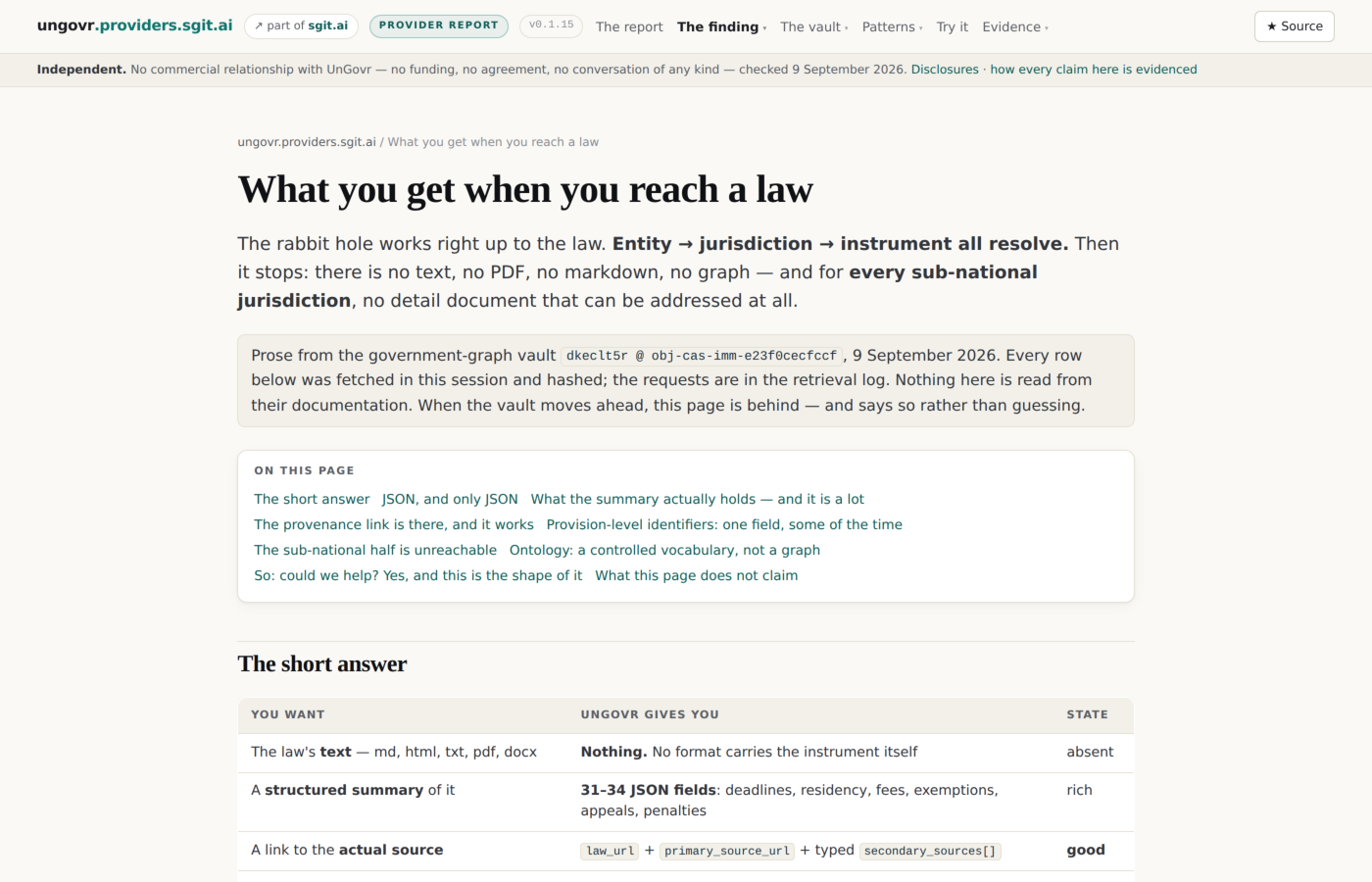
Follow the evidence to a law and UnGovr hands you a structured summary in JSON — 31 to 34 fields — and a link to the official publisher, on 392 of 398 laws across 339 hosts.
What it does not hand you: the text, in any format. .md.html.txt.pdf.jsonld.ttl all 404, and Accept: headers return byte-identical responses.
And 254 of the 398 laws — every sub-national one — have no reachable detail document at all.
Where the rabbit hole stops: JSON only, no instrument text, and 254 laws unreachable.
Notes. 24 of 24 sub-national slugs returned 404 against 26 of 26 national ones at 200. The jurisdiction carries a slash and the route is a single path segment. Sub-national is where the variation lives, and it is exactly the half the crosswalks point at.
What we plan to build · slide 6 of 10
The rule the whole design rests on
Don't merge vocabularies — merging erases the disagreement. Keep them intact and bridge them through anchor nodes.
graphs.sgit.ai, thesis sentence 6
Merging UnGovr's entity vocabulary into a standards vocabulary would destroy both. Bridging them costs one node class and one edge.
Notes. This is inherited, not invented, and it is why the pack proposes two anchors — ung:entity and ung:jurisdiction — rather than a schema everyone must adopt.
What we plan to build · slide 7 of 10
Fifteen edges, and the four that caught us out
Every edge is a verb with a distinct inverse. Six come from graphs.sgit.ai's established set, four from the AIUC-1 conformance layer, five are proposed here and marked as proposed.
The pack originally said eight were reused unchanged. Four of the six had been quietly renamed — observed_on given the inverse observation_of where the published set says bears_observation.
Renaming another vocabulary's inverses and calling it reuse is a fork.
File 02, republished from the vault — including the paragraph that was wrong about its own edges.
Notes. Caught by fetching the published edge set and comparing row by row, not by rereading our own table. It is the exact failure rule 6 exists to prevent, committed by the file that states the rule. The four are now theirs.
What we plan to build · slide 8 of 10
What we would supply, and what we would not
They supply
We supply
The instrument, found and summarised, with its publisher URL
Parsing it into provisions, each with a hash
254 sub-national jurisdictions, identified and slugged
The anchor binding a body to a place
A controlled vocabulary — 22 fields, 17 enums
Edges with named inverses
None of it requires their corpus to be redistributed, which matters because part of it cannot be.
Notes. The AI-law corpus licence says "No license is conveyed by receipt of this file". The graph can carry the anchor, the hash and the link, and leave the text where its licence requires it to stay. We have built the parsing half twice already — Regulation Graph from Formex, and the EU AI Act current text with a sha256 per provision.
What we plan to build · slide 9 of 10
The state of it: nothing is built, and the tests say so
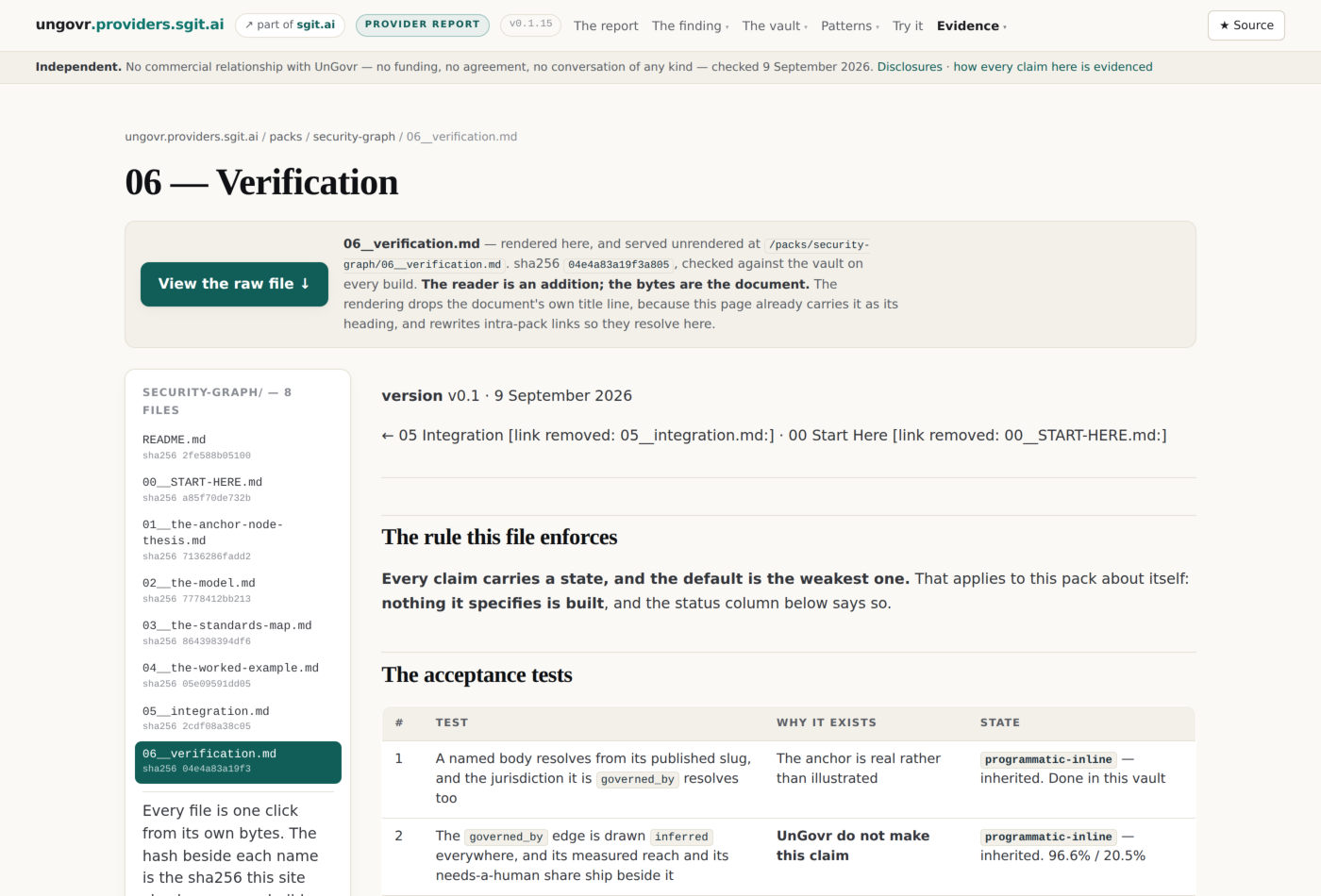
Thirteen acceptance tests. Five pass — and all five are inherited from work this vault had already done. One is asserted. Seven are unevidenced.
Four blockers are open. One, S1, closed on the day it was written by doing what the pack said to do first.
Thirteen tests, five passing, all inherited. The pack states what it has not earned.
Notes. This slide is the point of the deck. A specification published before its implementation, with the count of what it has not earned, is checkable against whatever gets built. The count itself was wrong first time — it said "two of twelve" — and was caught by parsing the table with a script rather than reading it.
What we plan to build · slide 10 of 10
What would make this wrong
S3 is the one that kills it. If UnGovr's entity ids churn between releases, the anchor thesis fails and nothing else in the pack survives. It is unmeasured. Two snapshots, compared, is the next cheapest thing to do.
S4: if a standards body already publishes machine-readable jurisdiction scope, their binding replaces our inference and should.
S5 is not closeable by us: the AI-law corpus cannot be redistributed.
Notes. End here rather than on a roadmap. The pack's own rule is that every claim carries a state and the default is the weakest one — that applies to the pack about itself. Nobody should leave this deck thinking any of it is built.
These slides are rendered from 04__what-we-plan.md, republished byte for byte from the vault. The live decks — the same file, parsed by the vault's own app — are in the Decks view of the vault, which moves the moment the vault does. This page moves when the site rebuilds.